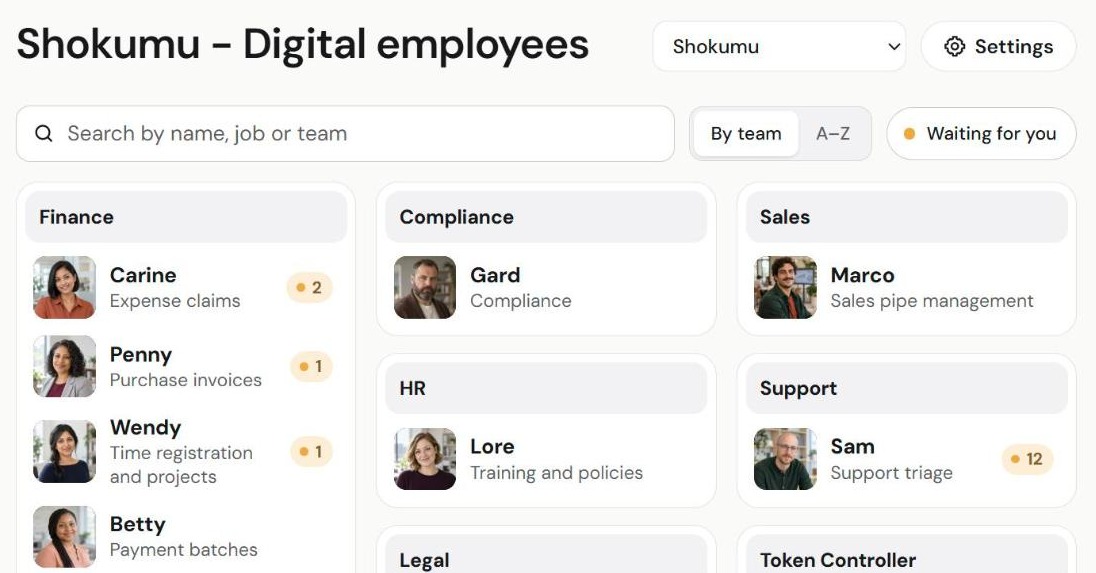
When people hear "digital employee", one of the first questions is: who is in charge of it? The answer is simple. Every digital employee reports to a human manager in your team, usually the person who is already responsible for the work today.
That is not a formality. It is how the whole thing works.
What the manager does
The manager of a digital employee does not need to know anything about AI. What they need is to know the job. Their role has four parts.
1. Agree on the job.
At the start, the manager helps describe what the job is and what it is not: which emails it handles, which systems it uses, when it should ask for help. The same conversation you would have with a new hire.
2. Review and correct.
In the first weeks, the manager and the team review the work. They approve it, adjust it or reject it. Each correction teaches the digital employee something, and goes back into its rules.
3. Decide on independence.
Based on what they see, the manager decides which work may go through without review. For example, orders from customers where the work has been right for weeks. That decision stays with the manager, and they can change it at any time.
4. Keep an eye on the work.
Afterwards, the manager sees what the digital employee did and where it asked for help. When the business changes, they flag it, and the role is updated together with us.
What the manager does not do
The manager does not maintain the software, update AI models or fix technical issues. That is our job. We stay responsible for how the digital employee performs for as long as it works for you.
How much time does it take?
More at the start, less later. In the first weeks, reviewing work takes real attention, much like coaching a new colleague. As independence grows, the manager mainly looks at the exceptions: the cases the digital employee sent to a person because a person was needed.
Why one person
You could make "the team" responsible, or IT, or a project group. In our experience that does not work well. Someone needs to feel ownership of the work, decide when something is good enough, and speak up when something changes. Just like for any other employee, that works best when it is one named person.
A role that grows
Many managers find the role grows on them. They see their own process more clearly than before, the team spends less time on repetitive work, and they decide where a digital employee should help next. In a way, they become the first managers of a mixed team, with human and digital colleagues working side by side.