
Which companies are digital employees for? We hear the question often. Our answer has two parts: small and medium-sized companies across Europe, and large companies with an AI taskforce. What both get from us is the same: a partner, not a software licence.
Small and medium-sized companies in Europe
Most small and medium-sized companies have no AI team, and do not plan to build one. They do have jobs that come back every day: orders by email, purchase invoices, bank lines, transport documents. And they do those jobs their own way, with rules that grew over the years.
Until recently, custom software for a job like that was too expensive for a company of that size. Writing software with the help of AI has changed that. What has not changed is that someone has to understand how the job really works, build it, and keep it working. That is what we do. The company brings the job and the people who know it. We bring the rest.
Large companies with an AI taskforce
Many large companies have set up an AI taskforce: a small team that collects ideas, sets priorities and has to show results. They rarely lack ideas. What they lack is the capacity to turn those ideas into work that runs every day, in a department, with a human manager who stays in control.
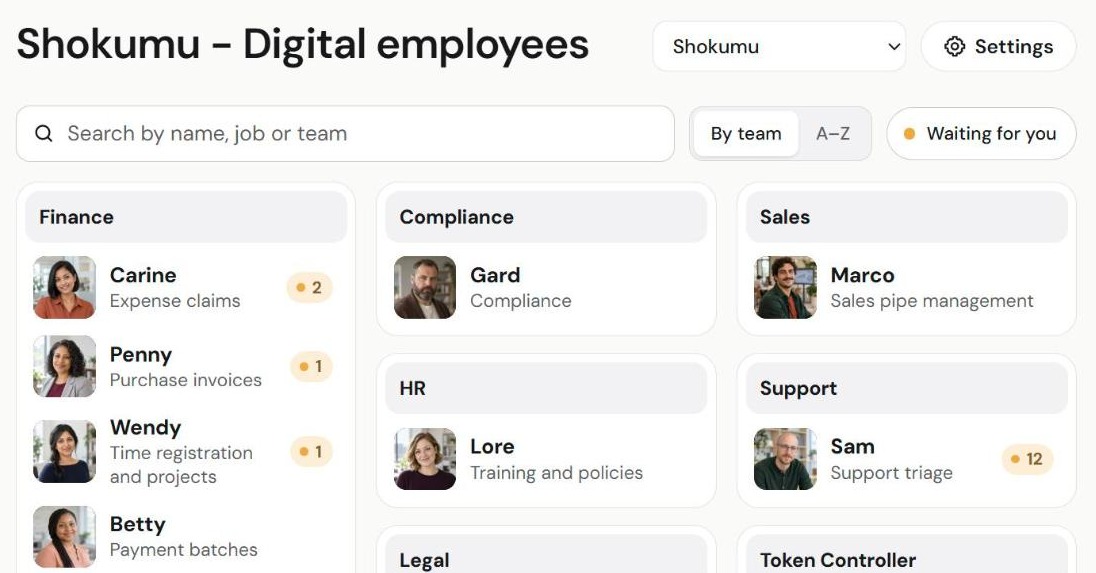
There, we work as a partner of the taskforce. The taskforce chooses the jobs and sets the rules for the company. We build the digital employees, onboard them with the teams, and stay responsible for them on one platform. The taskforce keeps the overview, without having to maintain every digital employee itself.
A partner, not a licence
There is another way to bring AI to companies: open up the software, and let the customer work it out, or hire a specialist to do it. We chose not to.
In The Discipline of Market Leaders, Michael Treacy and Fred Wiersema describe three ways a company can stand out: operational excellence, product leadership and customer intimacy. Market leaders choose one to excel at. We chose customer intimacy: knowing our customers' jobs, and staying close to the people who do them.
In practice, we are there for the whole career of every digital employee:
- choosing the job, with the people who do it today;
- building the digital employee for how your company does the job;
- onboarding, while your people review and correct the work;
- growing independence, as the human manager decides what may run without review;
- keeping up when your company, your systems or the AI models change.
We stay responsible for every digital employee for as long as they work for you.
What we do not do
Focus is a choice too. We build digital employees and help our customers grow a digital workforce, alongside their human employees. We do not coach teams in setting up personal AI agents, and we do not take on other kinds of AI projects. They can be useful. They are not what we do, and doing them would make us worse at what we do.
A company that hands a job to a digital employee needs one partner who knows that job, and stays. That is the partner we want to be. See how we work, from the first conversation to go-live.