Most AI projects start with an impressive demo. A document goes in, the right answer comes out, and everyone in the room nods.
But demos show the happy path. The real test begins months later.
What changes after go-live
A supplier changes its document format. A business rule evolves. A customer starts ordering in a different way. The underlying AI model gets updated by its provider. None of this is unusual. It is just what happens in a living company.
This is where many AI projects quietly break down. Nobody is sure who should fix it. The internal team does not know how it was built. The vendor sees it as a change request. And slowly, people go back to doing the work by hand.
Software first, AI where it adds value
Part of the answer is in how a digital employee is built. We build digital employees as software, with AI where it adds value. The steps, rules and decisions of the job are fixed in software, so the work is done the same way every time. AI is used where understanding is needed: reading an email, interpreting a document, handling something ambiguous.
That matters after go-live. When a rule changes, we change the rule. When a model changes, we test the job against real past work before anything goes live. The job does not drift on its own.
We stay responsible
The other part of the answer is responsibility. Once a digital employee is live, we stay accountable for how it performs, for as long as it works for you:
- When technology changes, we adapt it. Model updates, new versions and new systems are our job, not yours.
- When your business changes, we update the role together. A new product line or a new customer rule becomes part of the job.
- When your team corrects a result, it learns from it. Corrections go back into the rules, and every change is tested before it is released.
Your team does not need to become AI experts to keep it running. They need to do what they already do well: know the job and say when something is not right.
A human manager stays in charge
Through all of this, a human manager still decides what the digital employee may handle on its own, and where a person needs to look. That does not change after go-live. If anything, it becomes more important, because the manager is the one who notices when the work or the market shifts.
Performance you can see, every day
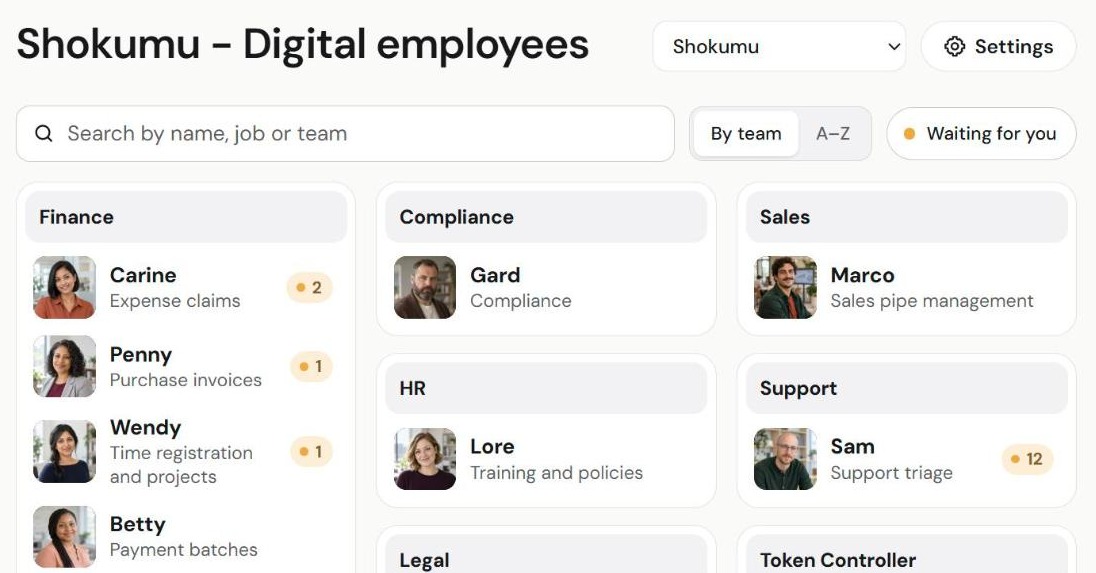
Every digital employee works on our platform for digital employees, and the platform monitors how it performs. Two questions matter most:
- Is the digital employee meeting its targets? And is it earning more independence, with more of its work going through without a person having to look at it?
- Is the human manager clearing the way? When something blocks the digital employee from finishing work on its own, does the manager act on it, so that more of the work can be completed automatically?
This is monitored continuously, and both the manager and we can see it. Not months after the facts, in an annual evaluation.
The question to ask
If you are planning an AI project, the demo is the easy part. Ask who keeps it running after go-live, how changes are tested, and who is responsible when something goes wrong. The answers tell you more than any demo.