There is a lot of excitement about AI agents: software in which an AI model receives a goal, then decides the steps, the tools it uses and when the work is done. For some work, that is exactly right. For the jobs a company does every day, we chose a different approach.
Same models, a different role
Digital employees and AI agents can use the same AI models. What differs is who decides how the job is done.
In an AI agent, the model is in charge. Every time it runs, it reasons about the next step. That is flexible and impressive in a demo. It also means the same request can take a different route tomorrow.
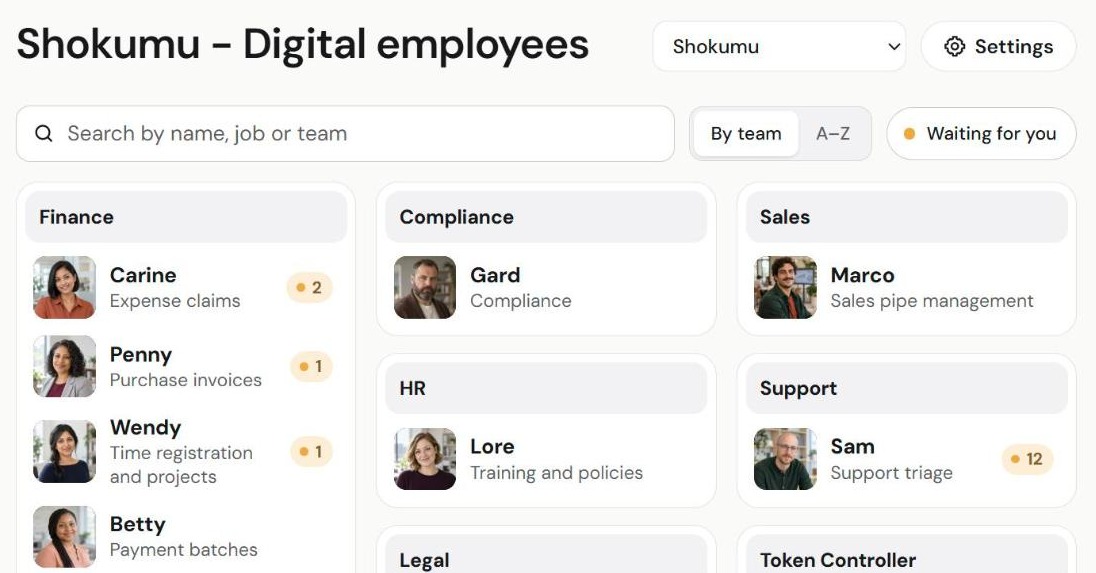
In a digital employee, the steps and rules of the job are fixed in software, the way the job is actually done in your company. AI works inside those steps, where understanding is needed: reading an email in any wording or format, matching a product description to your catalogue, working out what a customer meant with a note at the bottom of an order.
Why we chose this
The same job, done the same way. Your team, your auditors and your customers expect consistency. When the steps are fixed, an order processed today follows the same route as one processed next month.
Changes are deliberate. A digital employee does not change its own rules. People decide on the change, it is tested on real cases, and then it is released through the platform. That is how you treat important business software, and it is how we treat a digital employee.
You can see why something happened. Every step is recorded. When an order was approved automatically, you can see which rule allowed it. When it was sent to a colleague, you can see why.
Predictable speed and cost. The software steps run instantly. The model is only called where understanding is needed, instead of reasoning through every step, with retries and loops. That keeps both the speed and the cost per case predictable.
It knows its boundaries. An agent is eager to please: it tries to answer or act, even beyond what it should. A digital employee only has access to what its job requires, and what it may not decide goes to the right colleague.
AI does what it is good at. Language models are excellent at understanding messy input. They are less suited to being the only thing standing between a customer email and your ERP. We use them where they add the most value.
It is not "less AI"
This is sometimes read as being cautious about AI. It is the opposite. Fixed rules alone cannot take on a whole job. Within the steps, AI does the work that used to need a person: understanding what people write, recognising what something is, working out what is meant from context.
Because the structure around the AI is solid, we can put it to work in jobs where mistakes cost money, with a person reviewing the work until the human manager decides it may proceed on its own. The AI does more useful work precisely because it does not have to decide everything.
When an AI agent is the better choice
Not every task is a job that comes back every day. Where the question and the outcome are different each time, as in research, engineering or marketing, an agent’s freedom to find its own route is an advantage. Where the same job returns every day, you want it done the same, agreed way. That is where a digital employee fits.
What this means for you
You do not get a black box that "figures it out". You get a colleague with a clearly described job, rules you can read, a human manager who decides how independent it is, and a record of everything it did. When something needs to change, it changes because someone decided it should.
That is what we mean by a digital employee: one job, done the way your company does it.
Read the comparison of a digital employee and an AI agent: six differences that show in daily work, from the cost per case to their place in your organisation.