RPA or AI? Companies that want to take repetitive work off their teams often get the question in that form. It is the wrong question. RPA and AI solve different problems, and a job that comes back every day usually has both.
What RPA does well
RPA, robotic process automation, lets software repeat the steps a person takes on a screen: open a file, copy a field, paste it in another system, click save. It does the same steps every time. That makes it predictable and easy to check.
It works best when the input is just as predictable: the same form, the same fields, in the same place.
Where RPA stops
Real jobs rarely look like that. An order arrives by mail, as a PDF, a scan or a photo of a handwritten note. One customer writes "same as last week, but ten more". Another sends a change to yesterday's order.
A script cannot read that. Every variant needs its own rule, and what does not fit goes back to a person. The exceptions pile up where they always did, on your team's desk.
Then there is the upkeep. A script follows screens, so when a screen changes, after an update of your ERP or a new layout on a supplier portal, the script breaks. Someone has to notice, and fix it. Keeping a set of bots working is ongoing work, usually for a specialist, and it is easy to leave out of the business case.
What AI adds, and what it costs
AI can do what a script cannot. It understands what people write, even when the wording and format vary. It recognises what something is, and works out what is meant from context.
The tempting next step is to put an AI agent in charge of the whole job, and let it decide each time how to do it. Then the work is no longer done the same way every time. Results can vary, even with the same instructions, costs are hard to predict, and the work is harder to test, fix and change.
Software with AI
A digital employee takes the best of both. The steps and rules of the job are fixed in software, so the job is done the same way every time, as with RPA. AI is used within those steps, where understanding is needed.
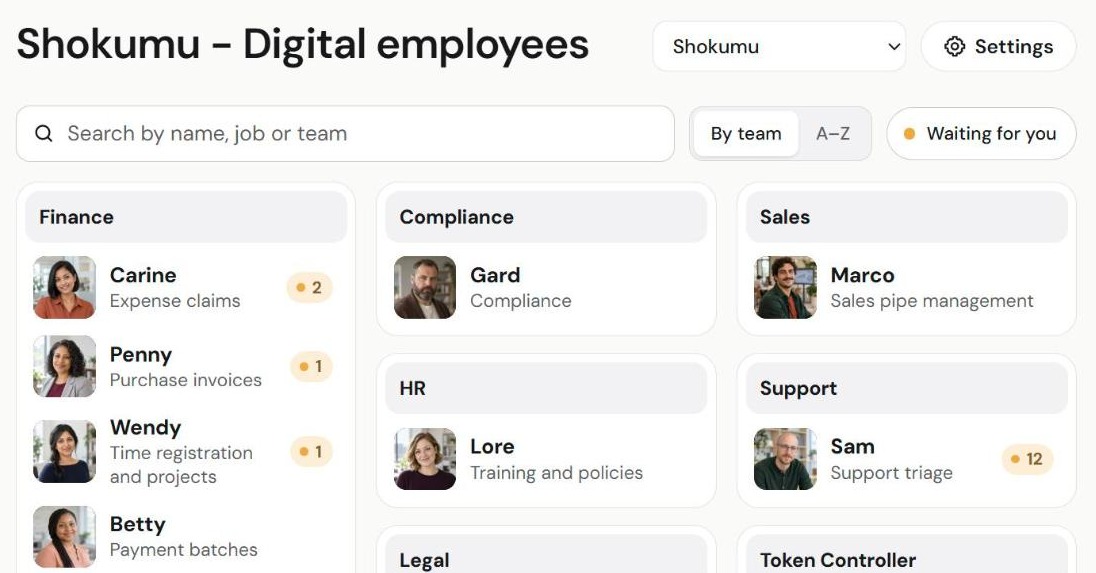
Katia, who does order entry at one of our customers, shows how that works. Software checks that a mail comes from an allowed sender. AI reads the order, in whatever format it arrives, and matches it to the customer's master data. Software applies the customer's quantity rules. Anything uncertain goes to a person, who decides.
We explain the difference with AI agents in more detail in Software with AI, not an AI agent.
And then: who does the job?
Many RPA platforms now add AI too. That brings the real question to the surface. An RPA bot or an AI agent is a tool: someone in your company builds it, maintains it, and fixes it when it breaks.
A digital employee takes on a job. They report to a human manager in your team, who decides what they may do on their own. And we stay responsible for them, for as long as they work for you.
So, RPA or AI? Neither, on its own. A job done the same way every time, AI where understanding is needed, and someone who stays responsible for it.